
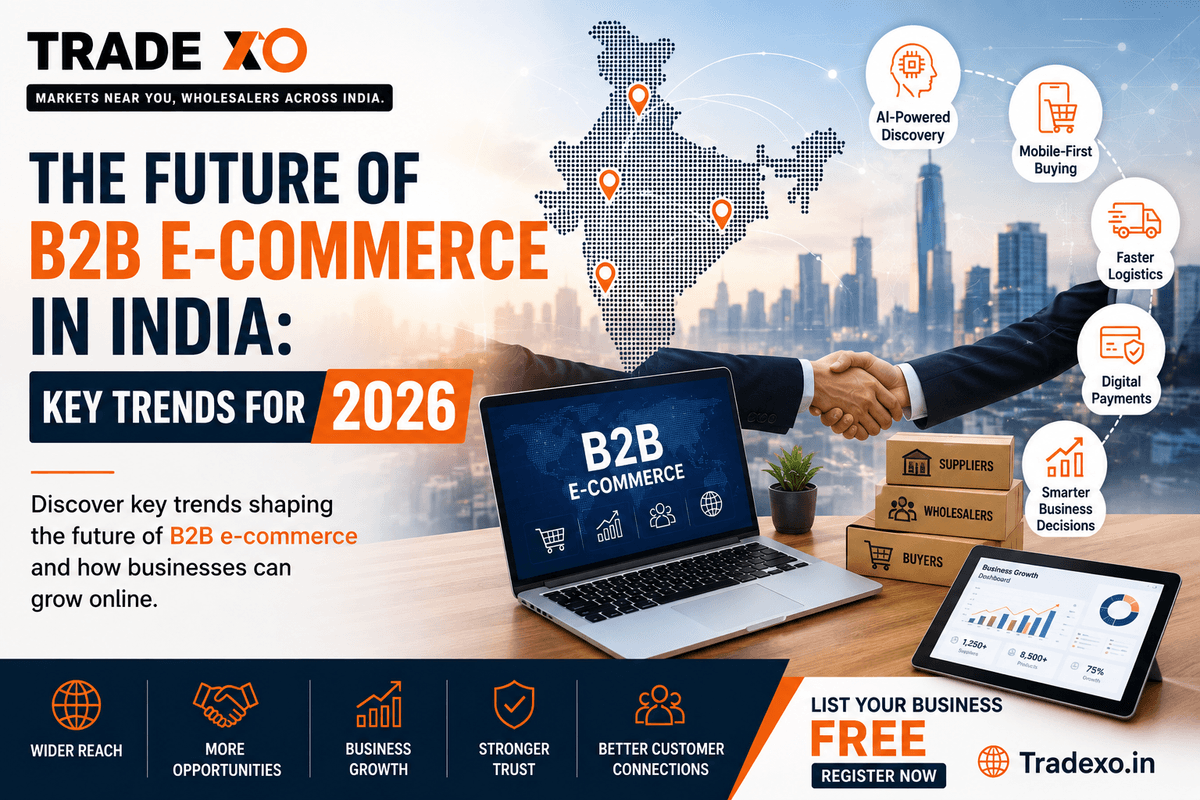
The Future of B2B E-commerce in India: Key Trends for 2026
India's B2B commerce landscape is changing rapidly.
Businesses that once depended mainly on physical markets, personal networks, phone calls and traditional distributors are increasingly using digital platforms to discover suppliers, promote products and connect with buyers.
India's wider e-commerce market is projected to reach around $250 billion by 2030, with AI-powered discovery, personalised experiences, smarter fulfilment and growing digital adoption helping drive the next phase of growth.
For manufacturers, wholesalers, suppliers, distributors and service providers, this creates a major opportunity: being discoverable online is becoming an important part of business growth.
Here are some of the key B2B e-commerce trends shaping India in 2026.
1. AI-Powered Business and Product Discovery
Artificial intelligence is becoming an increasingly important part of online commerce.
Instead of manually browsing hundreds of products or businesses, buyers can increasingly use smarter search, recommendations and AI-assisted discovery to find relevant products and suppliers.
For B2B businesses, this means having accurate and complete online information is more important than ever.
Businesses should clearly showcase:
The better your digital presence, the easier it can be for potential customers to understand what your business offers.
2. Mobile-First B2B Buying
Smartphones have changed the way Indian businesses communicate and search for information.
Business owners and buyers increasingly use mobile devices to search for suppliers, compare products, communicate with sellers and make purchasing decisions.
This makes mobile-friendly websites and business listings essential.
A B2B platform should make it easy for users to:
For businesses, having an online presence that works well on mobile can help them stay visible when potential buyers are searching.
3. Faster and Smarter Logistics
Logistics is another major part of the digital commerce transformation.
For B2B transactions, buyers often care about more than just product price. Delivery time, service area, reliability and fulfilment capabilities can also influence purchasing decisions.
Digital commerce networks are increasingly connecting sellers with logistics and technology providers, helping businesses participate in online commerce beyond their traditional local markets.
As logistics improves, businesses can potentially serve customers across wider geographic areas.
4. Digital Payments Are Becoming Standard
Digital payments have made online transactions faster and more convenient for Indian businesses.
UPI and other digital payment systems are helping businesses move from cash-heavy processes towards more convenient digital transactions.
For B2B businesses, digital payment adoption can help simplify:
The continued growth of digital commerce in India is closely connected with widespread digital payment adoption.
5. Local Businesses Are Going Online
One of the biggest opportunities in India's digital commerce growth is the increasing participation of businesses outside major metropolitan areas.
Tier-2, tier-3 and smaller cities represent an important part of India's next wave of online commerce growth.
A wholesaler in a smaller city no longer has to depend entirely on local customers.
With a strong digital presence, businesses can potentially become discoverable to customers searching from other cities and regions.
This is particularly important for
6. Business Discoverability Is Becoming More Important
Imagine a buyer searching online for:
"wholesale electrical suppliers near me"
or
"packaging material suppliers in Delhi"
or
"textile wholesalers in India."
If your business does not have a proper online presence, the buyer may never discover you.
This is why business listing and digital visibility are becoming important parts of modern B2B marketing.
A well-structured business profile can give potential customers useful information before they even contact you.
7. B2B Marketplaces Are Connecting Buyers and Sellers
B2B marketplaces help bring businesses, products and buyers together in one digital environment.
Open digital commerce initiatives such as ONDC are also focused on making digital commerce more accessible to businesses of different sizes and locations. ONDC describes its network as enabling businesses to become discoverable online and participate in digital commerce.
This broader shift shows that digital discoverability is becoming increasingly important for businesses across India.
8. Data Will Help Businesses Make Better Decisions
Digital platforms can provide businesses with valuable information about customer behaviour.
Businesses can use data to understand:
- Which products receive more interest
- Which locations generate enquiries
- Which categories attract customers
- Which marketing channels perform better
- Which products should be promoted
Over time, this can help businesses make more informed marketing and sales decisions.
9. Trust and Complete Business Information Matter
Online buyers want confidence before contacting a supplier.
A business profile with clear information can make it easier for potential customers to evaluate a company.
Businesses should focus on maintaining:
A complete online presence can help create a better first impression.
10. The Future Will Be Omnichannel
The future of B2B commerce is unlikely to be completely offline or completely online.
Instead, successful businesses will increasingly combine both.
A buyer may:
Search online → Compare businesses → Contact supplier → Visit store/factory → Place order → Continue relationship online
This means businesses should treat their online presence as an extension of their existing sales and marketing activities.
How Indian Businesses Can Prepare for the FutureBusinesses don't need to completely transform their operations overnight.
They can start with a few simple steps:
1. Create an online business presence
Make sure customers can find your business when searching online.
2. Keep your business information updated
Use accurate contact details, categories, locations and product information.
3. Showcase your products and services
Use clear descriptions and high-quality images.
4. Focus on mobile users
Make sure your website and online profiles are easy to use on smartphones.
5. Expand beyond your local market
Use digital platforms to become discoverable to potential buyers in other cities and regions.
6. Track your enquiries and customer interest
Use available data to understand what customers are looking for.
Why Business Listing Matters in 2026For many businesses, the first step towards digital growth is simply becoming discoverable online.
A business listing can provide potential customers with important information about what you sell, where you operate and how they can contact you.
For manufacturers, wholesalers, suppliers and service providers, this can become an important part of their digital marketing strategy.
List Your Business on Tradexo
Tradexo helps Indian businesses create an online presence where buyers can discover businesses, products and services.
Whether you are a manufacturer, wholesaler, supplier, distributor or service provider, getting your business listed online can help improve your digital visibility.
🚀 Create Your FREE Business Listing
Get discovered. Reach more buyers. Grow your business.
ConclusionB2B e-commerce in India is moving beyond simply selling products online.
The next phase is about better discovery, smarter technology, faster fulfilment, digital payments and wider business visibility.
AI, mobile-first experiences, logistics, digital commerce networks and growing adoption outside major cities are changing how businesses connect with customers.
For Indian businesses, the message is simple:
If your customers are searching online, your business should be there too.
Start building your digital presence today and make your business easier to discover.
List your business FREE on Tradexo.in.
Ready to Grow Your Business Online?
List your business on Tradexo and connect with thousands of buyers across India.